

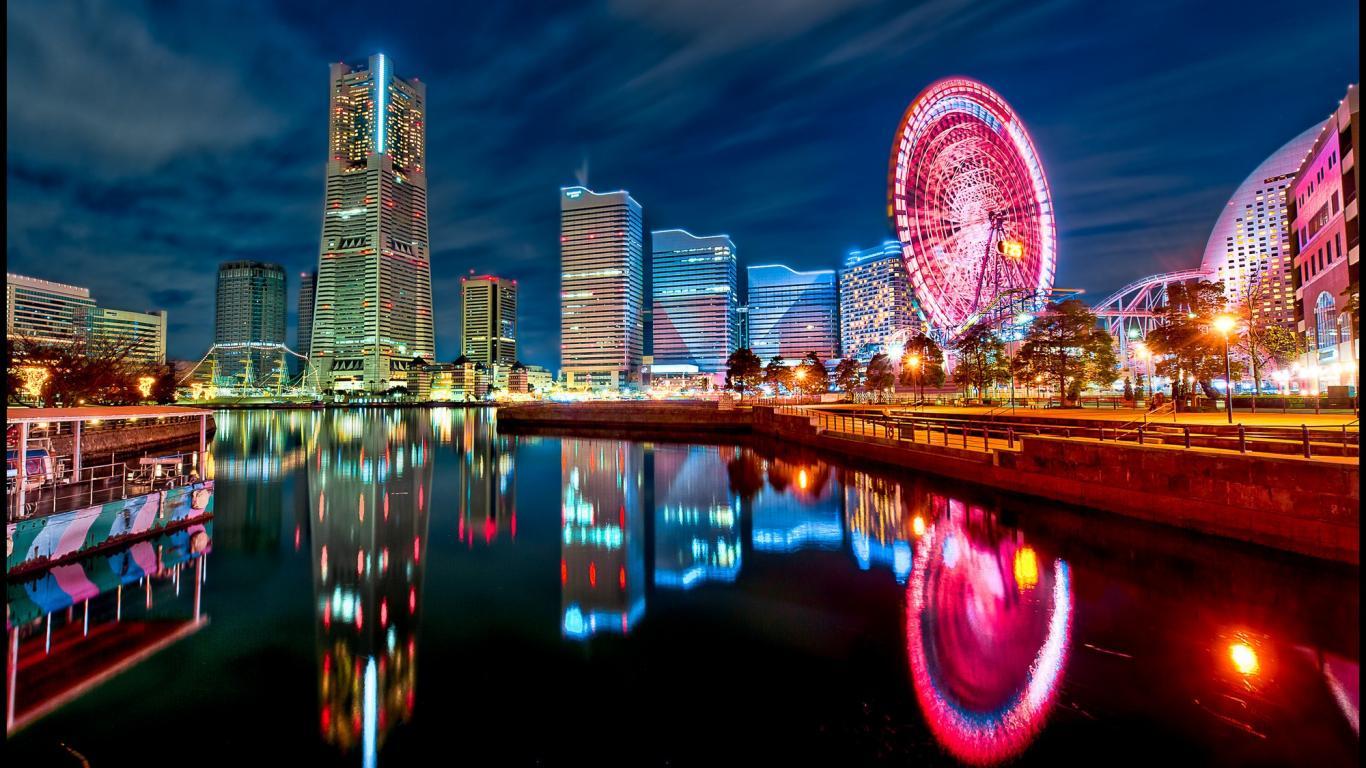
Yokohama stands as Japan’s second-largest city by both population and area, and serves as the country’s most populous municipality. With a population of approximately 3.7 million residents as of 2024, this vibrant port city functions as a major economic, cultural, and commercial hub within the Greater Tokyo Area. Located on Tokyo Bay south of Japan’s capital, Yokohama occupies a strategic position in the Kantō region on the island of Honshū.
Historically, Yokohama transformed from a modest fishing village into a cosmopolitan global port city following Japan’s opening to foreign trade in the mid-19th century. This dramatic metamorphosis established Yokohama as a gateway for Western influence and technological innovation, shaping its development into one of the world’s most important maritime centers. Today, the city epitomizes Japan’s blend of traditional heritage and cutting-edge modernity.
Table of Contents
Etymology and Geographical Significance
The name “Yokohama” derives from two Japanese characters meaning “horizontal beach.” This etymology reflects the city’s geographical origin—the area was distinguished by a sandbar extending perpendicularly from the land that, when viewed from the sea, appeared horizontal. Historically, this feature created a gulf separated from the open ocean, upon which the original fishing settlement developed its foundations.
History
Early Period and the Opening of Japan
Before the arrival of Europeans, Yokohama remained a small, isolated fishing village throughout Japan’s feudal Edo period, when the nation maintained a strict policy of national seclusion with minimal foreign contact. The city’s fate changed dramatically in 1853-1854 when Commodore Matthew Perry arrived just south of Yokohama with a American naval fleet, compelling Japan to open several ports to foreign trade. The Tokugawa shogunate accepted these demands through the Treaty of Peace and Amity, forever altering the trajectory of Japanese history.
When negotiations began regarding which ports to open, authorities initially designated Kanagawa-juku, a town on the strategically important Tōkaidō highway connecting Edo to Kyoto and Osaka. However, the shogunate deemed this location too close to this vital route and instead established port facilities in the fishing village of Yokohama across an inlet. On June 2, 1859, the Port of Yokohama officially opened, inaugurating a new era of international commerce and cultural exchange.
The Meiji Era: Emergence as a Global Port
Yokohama rapidly became Japan’s primary hub for foreign trade following the port’s establishment. Foreign residents initially concentrated in the low-lying Kannai district, gradually expanding into elevated areas such as the Yamate district, colloquially known as “The Bluff” among English-speaking expatriates. The Kannai district itself, literally meaning “inside the barrier,” was surrounded by a protective moat and granted extraterritorial status to foreign residents.
The city witnessed numerous “firsts” for Japan during this transformative period. These groundbreaking achievements included establishing Japan’s first foreign trading port and Chinatown in 1859, constructing European-style sports venues in the 1860s, publishing the nation’s first English-language newspaper (the Japan Herald) in 1861, and initiating confectionery and beer manufacturing in 1865. Recreational sports introduced by foreign residents included horse racing beginning in 1862, cricket in 1863, and rugby union in 1866.
Following the Meiji Restoration of 1868, the port was extensively developed to facilitate the silk trade, with Great Britain serving as the primary trading partner. Western technological influence led to the establishment of Japan’s first daily newspaper in 1870, the installation of gas-powered street lamps in 1872, and the construction of Japan’s pioneering railway line that same year, connecting Yokohama to Shinagawa and Shinbashi in Tokyo. In 1887, merchant Samuel Cocking built the city’s first power plant, initially for private use before becoming the foundation for the Yokohama Cooperative Electric Light Company.
By 1899, when extraterritorial protections were abolished, Yokohama had established itself as Japan’s most international city, with foreign communities stretching from Kannai through the Bluff area and encompassing the substantial Yokohama Chinatown.
Industrial Growth and Disaster
The early twentieth century brought rapid industrial expansion. Entrepreneurs established factories on reclaimed land north of the city toward Kawasaki, which eventually developed into the Keihin Industrial Area. This growth brought prosperity to wealthy trading families who constructed grand residences, though rapid population influx from Japan and Korea also created Kojiki-Yato, at the time Japan’s largest slum.
On September 1, 1923, catastrophe struck when the Great Kantō earthquake devastated much of Yokohama. Police records documented 30,771 deaths and 47,908 injuries from a population of 434,170. Rumors and suspicion led vigilante mobs to murder many Korean residents in the Kojiki-Yato slum. Military rule remained in effect until November 19, 1923. Paradoxically, reconstruction efforts utilized earthquake rubble to reclaim land for parks, most notably the famous Yamashita Park on the waterfront, which opened in 1930.
World War II and Recovery
Yokohama’s rebuilt infrastructure was devastated once more during World War II by American bombing campaigns. The first attack occurred during the Doolittle Raid on April 18, 1942. More catastrophically, the Great Yokohama Air Raid of May 29, 1945, killed approximately 7,000-8,000 residents in a single morning when B-29 Superfortress bombers firebombed the city, reducing 42 percent of it to rubble in just over an hour.
Following the American occupation, Yokohama served as a crucial transshipment base for American supplies and personnel, particularly during the Korean War. Subsequently, most American naval activity relocated from Yokohama to a base in nearby Yokosuka.
Modern Development
Yokohama was designated a city by government ordinance on September 1, 1956, four years after the Treaty of San Francisco. The city’s historic tram and trolleybus system was abolished in 1972, the same year the Yokohama Municipal Subway opened its first line. Beginning in 1983, the massive Minato Mirai 21 urban development project transformed reclaimed land into a modern district. This ambitious undertaking earned comparisons to Center City Philadelphia and Downtown Boston, giving rise to the nickname “the Philadelphia and Boston of the Orient.”
The Yokohama Exotic Showcase of 1989 featured the first public operation of Japanese maglev trains and inaugurated the Cosmo Clock 21, then the world’s tallest Ferris wheel. The same year saw completion of the 860-meter Yokohama Bay Bridge. In 1993, the district welcomed the Yokohama Landmark Tower, the second-tallest building in Japan at the time.
Yokohama hosted the 2002 FIFA World Cup final at the International Stadium Yokohama in June. The city commemorated its 150th port anniversary and 120th year of city administration in 2009, hosting the Fourth Tokyo International Conference on African Development (TICAD IV) in May 2008. In November 2010, Yokohama hosted the Asia-Pacific Economic Cooperation (APEC) meeting.
Geography and Climate
Physical Geography
Yokohama encompasses a total area of 437.38 square kilometers at an average elevation of just five meters above sea level. Located on Tokyo Bay and surrounded by hills characteristic of Honshū’s mountain systems, the city’s growth has been constrained by natural geography. Consequently, Yokohama has developed extensive reclaimed land from the sea, resulting in one of Japan’s highest population densities at approximately 8,500 inhabitants per square kilometer.
The highest points within the urban area are Omaruyama at 156 meters and Mount Enkaizan at 153 meters. The Tsurumi River, originating in the Tama Hills, represents the city’s main waterway, emptying into the Pacific Ocean. Yokohama is surrounded by several municipalities including Kawasaki, Yokosuka, Zushi, Kamakura, Fujisawa, Yamato, and Machida.
Natural Hazards
The city’s location on the Pacific Ring of Fire makes it prone to earthquakes and tropical cyclones. Most seismic activity consists of low-intensity movements imperceptible to residents. However, two major tremors have significantly impacted the city and influenced earthquake engineering development. The 1923 Great Kantō earthquake devastated Yokohama and caused over 100,000 fatalities across the broader region. The 2011 Tōhoku earthquake and tsunami, originating from the east coast, was felt in Yokohama but caused only material damage due to modern building standards designed to withstand such events.
Climate
Yokohama features a humid subtropical climate with hot, humid summers and cool winters. Winter temperatures rarely drop below freezing, and the winter season is surprisingly sunny, even compared to Southern Spain. Summer warmth is intensified by humidity levels. The coldest temperature on record was −8.2°C on January 24, 1927, while the highest was 38.1°C on August 6, 2025. October 2004 saw the highest monthly rainfall at 761.5 millimeters.
Population and Demographics
Current Population Statistics
Yokohama’s population stands at 3,772,726 as of June 1, 2024, making it Japan’s second-most populated city after Tokyo’s special wards. Among the city’s 18 wards, Kohoku is the most populous with 364,760 residents, followed by Aoba (308,379), Tsurumi (297,230), and Totsuka (282,601). The wards of Nishi and Minami exhibit the highest population density, exceeding 15,000 residents per square kilometer.
Importantly, approximately 1,548,077 Yokohama residents work outside the city, primarily in Tokyo, while 1,226,618 workers commute into Yokohama. This pattern reflects the city’s function as both a residential center and employment destination, with many residents serving as commuters to neighboring urban areas.
Foreign Population
As of June 2024, Yokohama’s foreign national population totaled 121,042, comprising 3.2 percent of the total population—a significant increase in recent years. The three countries with the largest expatriate communities exceeding 10,000 nationals are all Asian: China, South Korea, and Vietnam. Other major countries of origin include Brazil (2,823), the United States (2,793), Peru (1,312), the United Kingdom (840), and Germany (770).
Government and Administration
Yokohama holds the status of one of Japan’s 20 designated cities, conferring governmental powers typically reserved for prefectural authorities. The city comprises 18 administrative wards, with the city government headquartered in Naka Ward. The 86-member Yokohama City Council is elected from all 18 wards, with the Liberal Democratic Party maintaining minority control with 36 seats. Takeharu Yamanaka serves as the incumbent mayor following his 2021 election victory over his predecessor Fumiko Hayashi.
Economy
Economic Output
In 2020, Yokohama’s total gross regional product reached 14.06 trillion yen (approximately US$133 billion), though this represented a 1.9 percent decrease from the previous year due to the COVID-19 pandemic. This converts to approximately US$35,107 per citizen, slightly below the national average. The economic discrepancy reflects that many Yokohama residents generate economic value outside the city, primarily in Tokyo, which does not contribute to Yokohama’s local figures.
Major Industries and Sectors
The largest contributors to Yokohama’s economy are wholesale and retail (17.8%), healthcare services (11.7%), and academic, professional, and technological services (11.0%). The city serves as headquarters for numerous major corporations, including automotive manufacturers Isuzu and Nissan, electronics companies JVCKenwood, transportation operator Keikyu Railway, game developer Koei Tecmo, transit company Sotetsu, and the Bank of Yokohama.
Port Operations
Yokohama ranks as the world’s 31st largest seaport in total cargo volume, handling 121,326 freight tons as of 2011, and ranks 37th globally in Twenty-foot equivalent units (TEUs). In 2013, APM Terminals Yokohama facility earned recognition as the world’s most productive container terminal, averaging 163 crane moves per hour per ship between vessel arrival and departure.
Tourist Attractions and Cultural Sites
Yokohama offers diverse attractions appealing to visitors with varied interests, combining historical landmarks, modern entertainment, natural beauty, and cultural institutions.
Iconic Landmarks
Minato Mirai 21 represents the city’s most ambitious modern development, featuring contemporary architecture, shopping, dining, and entertainment. The Yokohama Landmark Tower rises 296 meters, making it the third-tallest skyscraper in Japan, with observation decks providing panoramic city views. The Cosmo Clock 21, a massive Ferris wheel in Minato Mirai, offers distinctive perspectives of Yokohama Bay and surrounding areas.
Nippon Maru, a historic sailing ship preserved as a museum vessel, exemplifies Yokohama’s maritime heritage, while the adjacent Nippon Maru Memorial Park celebrates the city’s naval history. Yamashita Park, constructed from earthquake rubble following the 1923 disaster, offers waterfront recreation and scenic beauty along the harbor.
The Yokohama Marine Tower provides coastal observations, and the Yokohama Bay Bridge, stretching 860 meters, connects the city to surrounding areas while offering distinctive silhouettes in the cityscape. Motomachi Shopping Street preserves historic commercial character with contemporary retail offerings.
Museums and Cultural Institutions
Yokohama hosts 42 museums throughout its administrative area, offering comprehensive cultural experiences. The CupNoodles Museum celebrates the invention of instant ramen by Momofuku Andō, featuring interactive exhibits and cooking demonstrations. The Kanagawa Prefectural Museum of Cultural History operates from the historic Yokohama Specie Bank building, preserving regional artistic and historical treasures.
The Kanazawa Bunko preserves traditional Japanese and Chinese art objects dating from the Kamakura period, while the Matsuri Museum celebrates shrine festivals integral to Japanese culture. The Shin-Yokohama Rāmen Museum provides comprehensive ramen history alongside a themed food court.
The Yokohama Archives of History, housed in the former British Consulate, examines port development and Matthew Perry’s arrival through detailed exhibitions. The Yokohama Museum of Art, founded in 1989, showcases modern works by celebrated international and Japanese artists. The Yokohama Silk Museum highlights production and processing of silk, a historical cornerstone of Yokohama’s trade legacy.
Historical and Religious Sites
Gumyōji temple represents the oldest religious structure in Yokohama, offering spiritual atmosphere amid urban surroundings. Iseyama Kotai Shrine provides traditional Shinto worship experiences. The Yokohama Foreign Cemetery preserves the burial sites of early Western residents and diplomats, functioning as an open-air museum of Yokohama’s multicultural heritage.
Sankei-en Garden offers traditional Japanese aesthetic beauty with preserved historical structures and seasonal plantings. Harbor View Park provides sweeping vistas of Yokohama Bay, while the Hikawa Maru historic passenger and cargo ship serves as a museum vessel documenting maritime transportation history.
Shopping and Entertainment
The Motomachi Shopping Street blends historic charm with contemporary retail, while Yokohama World Porters and Mitsui Outlet Park Yokohama Bayside cater to shopping enthusiasts. The Yokohama Municipal Kanazawa Zoo provides family entertainment, and the Yokohama Triennale celebrates contemporary art through rotating exhibitions.
Tourism Statistics
In 2016, Yokohama attracted 46,017,157 tourists, with 13.1 percent staying overnight, indicating the city’s significant appeal as both a day-trip destination from Tokyo and a independent tourism draw.
Sports and Recreation
Professional Sports Teams
Yokohama supports multiple professional sports franchises across various disciplines. The Yokohama DeNA BayStars compete in professional baseball, playing at Yokohama Stadium, while Yokohama FC and Yokohama F. Marinos represent the city in Association football’s J1 League. The YSCC Yokohama competes in the Japan Football League, and NHK Yokohama FC Seagulls participates in the Nadeshiko League (women’s professional soccer).
Additional professional teams include the Yokohama B-Corsairs in basketball, the Yokohama Grits in ice hockey, the Yokohama Eagles in rugby union, and the Yokohama Harbors in American football. The Kagetsu-en Velodrome hosts track cycling events, while tennis player Ai Sugiyama maintains connections to the city.
Sports Infrastructure
Yokohama provides extensive sports facilities for both professional and recreational purposes. The city’s venues have hosted major international events, most notably the 2002 FIFA World Cup final at International Stadium Yokohama. The Yokohama Arena serves as a multipurpose entertainment and sports venue, while Nissan Stadium hosts soccer matches and major events.
Transportation
Comprehensive Transit Network
Yokohama benefits from an extensive and well-integrated transportation network facilitating movement within the city and connections to surrounding areas. The Tōkaidō Shinkansen high-speed rail line maintains a station at Shin-Yokohama, connecting to major Japanese cities. Yokohama Station itself serves as a major transportation hub, processing approximately two million passengers daily.
The Yokohama Municipal Subway operates two lines—the Blue Line and Green Line—providing metro coverage throughout the city. The Minatomirai Line and Kanazawa Seaside Line offer additional rail connectivity. Multiple private railway companies supplement municipal services, including Keikyu, Tokyu Railways, and Sagami Railway, collectively providing comprehensive regional access.
Railway Services
East Japan Railway Company (JR East) operates several lines through Yokohama, including the Tōkaidō Main Line, Yokosuka Line, Keihin-Tōhoku Line, Negishi Line, Yokohama Line, Nambu Line, and Tsurumi Line, connecting various wards and surrounding municipalities. Keikyu Railway operates the Keikyu Main Line and Keikyu Zushi Line, while Tokyu Railways provides the Tōyoko Line, Meguro Line, Den-en-toshi Line, and specialized routes.
Yokohama Minatomirai Railway operates the Minatomirai Line connecting central areas to the modern Minato Mirai district, while Yokohama New Transit operates the Kanazawa Seaside Line serving southern coastal areas.
Airport Access
While Yokohama lacks its own airport, residents enjoy convenient access to Tokyo’s two major aviation hubs. Haneda Airport lies approximately 17.4 kilometers away, while Narita International Airport is situated 77 kilometers distant. Both facilities provide extensive domestic and international flight connections.
Education
Educational Institutions
Public elementary and middle schools throughout Yokohama are operated by the city, ensuring consistent educational standards. Nine public high schools operate under the Yokohama City Board of Education, while numerous additional public high schools fall under Kanagawa Prefectural Board administration.
Higher education is represented by 16 universities with approximately 83,000 students enrolled. Yokohama National University ranks as the city’s leading university, establishing the city as an important education center. Public library services are substantial, with 19 public libraries facilitating 9.5 million loans in 2016.
Educational Statistics
Yokohama’s educational system serves 46,388 children across 260 kindergartens, while nearly 386,000 students attend 351 primary schools, reflecting the city’s role as an important family residential destination.
Cultural References and Media
Yokohama’s distinctive character and rich history have inspired numerous creative works across literature, film, anime, manga, and video games. Jules Verne’s classic novel “Around the World in Eighty Days” features Yokohama as a crucial stop, capturing the fast-developing, internationally oriented character of the nineteenth-century city.
Yukio Mishima’s novel “The Sailor Who Fell from Grace with the Sea” is primarily set in Yokohama, describing the city’s port, housing influenced by Western architecture, and multicultural atmosphere. Studio Ghibli’s 2011 animated film “From Up on Poppy Hill,” directed by Gorō Miyazaki, is set in Yokohama’s Yamate district, celebrating the city’s post-war reconstruction period.
James Clavell’s historical novel “Gai-Jin” takes historical Yokohama as its primary setting, exploring early foreign-Japanese interactions. Akira Kurosawa’s 1963 film “High and Low” was filmed and set in Yokohama, utilizing the city’s urban landscapes.
Contemporary media frequently features Yokohama. Vermilion City in the Pokémon franchise is explicitly based on Yokohama, leading to the city hosting the 2023 Pokémon World Championships at Pacifico Yokohama. The manga series “Bungo Stray Dogs” and “Komi Can’t Communicate” are set in Yokohama, with the latter featuring numerous city landmarks.
Video games incorporating Yokohama include “Yakuza: Like a Dragon,” which is set in Isezaki Ijincho, a fictional district based on actual Isezakichō. “The Caligula Effect” features Miyabi City, based on Yokohama with recognizable landmarks like the Landmark Tower and Yokohama Hakkeijima Sea Paradise. “Persona 2” features Sumaru City, inspired by Yokohama’s urban layout and character.
Anime and other projects set in Yokohama include “My Hero Academia” (featuring the Nomu Warehouse), “Pretty Cure All Stars New Stage: Friends of the Future” (appearing atop Cosmo Clock 21), “Hamatora,” “After the Rain,” and “Hypnosis Mic: Division Rap Battle.”
Sister Cities and International Relations
Yokohama maintains sister city relationships with eight municipalities worldwide, established through formal agreements. These include Constanța (Romania, since 1977), Lyon (France, since 1959), Manila (Philippines, since 1965), Mumbai (India, since 1965), Odesa (Ukraine, since 1965), San Diego (United States, since 1957), Shanghai (China, since 1973), and Vancouver (Canada, since 1965). The city also maintains friendship city relationships and port-to-port agreements with numerous additional municipalities globally.
Notable Residents
Yokohama has produced and been home to numerous accomplished individuals across diverse fields. These include professional athletes such as basketball player Yuta Watanabe (Toronto Raptors), boxer Naoya Inoue, figure skater Yuma Kagiyama, and multiple racing drivers. Entertainment personalities include singers Toru Furuya, Crystal Kay, Takehito Koyasu, and Masahiko Kondō, as well as actress Yūta Mochizuki.
Professional wrestlers and sports figures include Antonio Inoki (wrestler and politician), Hana Kimura, Kyoko Kimura, and others. Astronaut Soichi Noguchi represents Japan’s space exploration efforts. The band Radwimps brings contemporary alternative rock prominence to the city. These individuals reflect Yokohama’s status as a cosmopolitan center producing talent across multiple disciplines.
MORE ON: How to Get to Yokohama